Unique event puts Carolina at center of AI conversation
The inaugural Converge-Con AI convention will take place Oct. 22-24 in Chapel Hill.
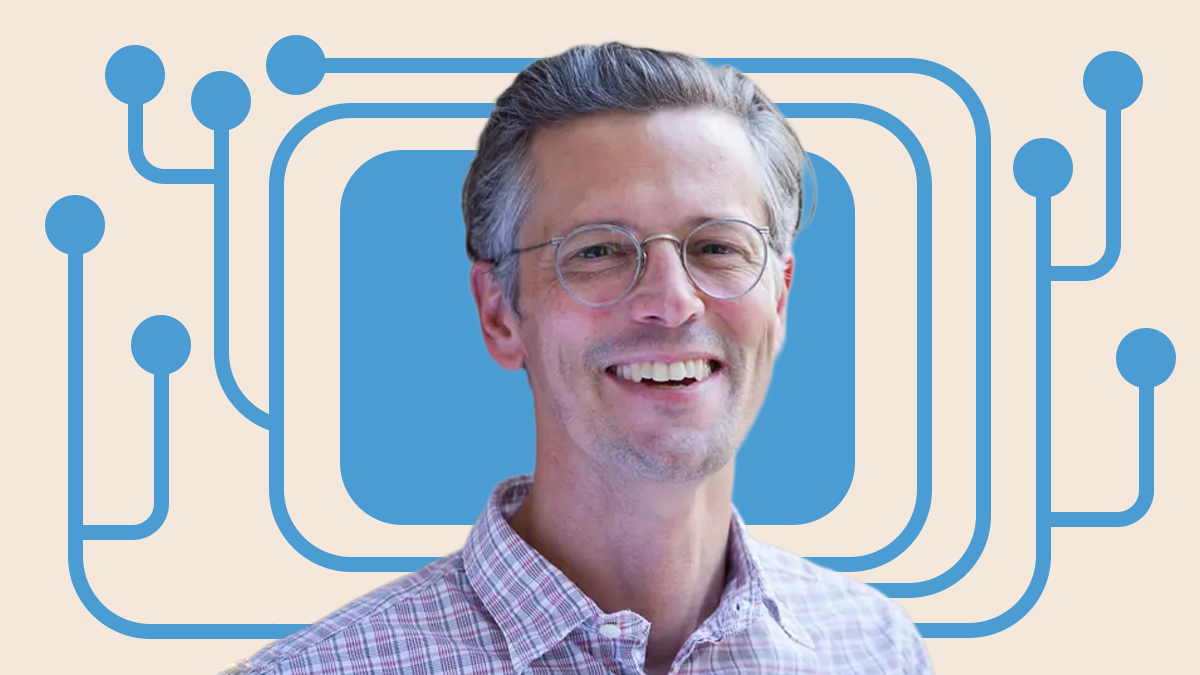
Nearly two decades ago, Scott Geier was studying philosophy at Davidson College and delving into existential questions about artificial intelligence. At that point, AI was only an abstract concept – a futuristic dream. Geier wasn’t sure he’d see it in his lifetime.
Fast forward to 2025, and AI is now everywhere – and evolving daily. Yet many philosophical and ethical questions remain.
Since joining the UNC Hussman School of Journalism and Media as an assistant professor in 2023, Geier has made AI a central part of his work, calling it “the most important thing happening in the world.” He’s had countless conversations with industry leaders, CEOs and philosophers to better understand how AI is being used and the implications of that use. In his own classroom, Geier asks students to use AI for homework and provide their own “human-bot reflections.”
Some of those conversations have been exhilarating, others frightening. But the more Geier dug into AI, the more he realized a larger, public conversation needed to take place. That’s how Converge-Con – Hussman’s first AI convention – was born.
The unique, interactive convention is open to the public and will take place Oct. 22-24 at various campus locations (a full schedule can be viewed on the Converge-Con website). In designing the event, Geier said he wanted to create a gathering similar in atmosphere to South by Southwest in Austin, Texas.
“It’s not just an academic conference. It’s a tech cultural event. It’s art; it’s music,” Geier said. “The idea is: Let’s talk about this and start creating a buzz as UNC being where the conversation is happening.
“AI has potential to do amazing things, and we’re going to showcase some of those. But there’s also some problems, and we’ll talk about those. This is where the conversation is happening, and especially as a school of communication, it’s important for us to take on that role.”
‘The good, bad and the ugly’
As planning for Converge-Con took place, the convention blossomed from a Hussman event into a campus-wide collaboration.
Converge-Con was created in partnership with the UNC School of Law, the UNC College of Arts and Science’s Parr Center for Ethics, the Center for Faculty Excellence and with Innovate Carolina Junction, which will host several of the convention’s events and speakers.
Converge-Con features a wide array of speakers to cover every angle of AI, or as Geier calls it, “the good, bad and the ugly.”
Speakers include corporate heavyweights like Peter Sherman, the head of innovation, integration and growth at Omnicom – the world’s largest marketing services company – and Rob Bernstein, the chief innovation officer at the global public relations firm Ketchum. Other guests come from media giants like CNN, McClatchy and The Wall Street Journal as well as current Carolina faculty.
Events will go beyond panel discussions and will include interactive components, like an AI music session with Carolina professors Mark Katz and Pablo Vega, as well as an immersive, AI-driven art experience by renowned media and lighting designer Tao Wang.
On Oct. 24, the School of Law will hold a first-ever mock criminal trial with an all-AI jury in its on-campus courtroom. Human law students will serve as prosecutor, defense attorney and witnesses, but the case will be decided in real time by three AI programs.
All the while, there will be plenty of room for feedback, questions and comments from audience members.
“The culmination of Converge-Con, in terms of the talking head part, is a huge town hall, and it’s called ‘Risk/Reward,’” Geier said. “It’s going to be an expert representing each of the potentially catastrophic risks of AI: the environment, the stress on the power grid, bias, deep fakes, job loss. Is this a threat to us as a species?
“I’m going to be the moderator, and there will be a room of 450 students. I’ll hand them a mic, and ask them, ‘What’s on your mind? How do you feel about this?’ I want lights, camera, action on UNC having a very important conversation about all of this.”