‘Stubborn’ astronomer makes major ‘lost sisters’ finding
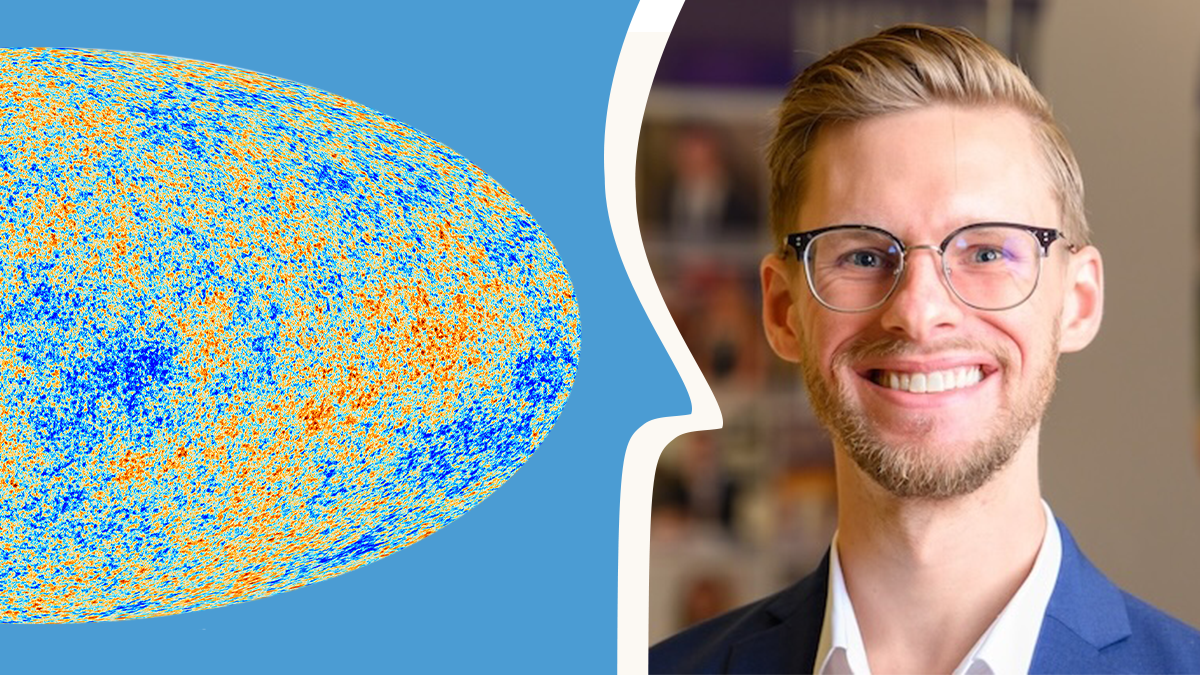
Carolina graduate student Andrew Boyle and collaborators discovered the Seven Sisters Pleiades star cluster numbers in the thousands.

Growing up in Colorado, Andy Boyle spent summers camping in the mountains with his cross-country teammates. He gazed at the night sky, staring in wonder at the twinkling stars.
As an undergraduate at the University of Colorado Boulder, he took astronomy classes and resolved to pursue a career in the field — but the journey wasn’t easy. Boyle applied to graduate programs for years before he found one that accepted him. At one point, an adviser suggested he pursue a different field.
“I’m very glad I was stubborn and didn’t listen to him,” said Boyle, now a Carolina graduate student in the UNC College of Arts and Sciences’ physics and astronomy department.
Not only has Boyle found a home at UNC-Chapel Hill, but his work has drawn global attention. Boyle is the lead author of a significant new study in The Astrophysical Journal that changes the way astronomers view one of the most famous and well-studied star clusters in the universe.
Boyle and his fellow astronomers discovered that the Pleiades star cluster, known as the Seven Sisters, comprises much more than seven stars. By combining data from NASA’s Transiting Exoplanet Survey Satellite and the European Space Agency’s Gaia space telescope, the team uncovered thousands of long-lost Pleiades siblings — or “lost sisters” — that have drifted through the universe over millions of years.
Using stellar spin rates and motion data, Boyle and the team determined that the seven stars we refer to as the Pleiades are the core of a stellar family 20 times larger than previously thought. That family, known as the Greater Pleiades Complex, comprises at least 3,000 stars — and Boyle said that estimate could be conservative.

“In reality, there’s actually far more stars,” Boyle said. “Because our methodology excludes the faintest and coldest stars, that means that we’re missing most of the stars that are part of this cluster. In our membership list, we have about 3,000 stars. I did the calculation, and if you’re able to recover all the stars, there’d be 8,000 to 10,000.”
The findings have massive implications for astronomers, who have long used the Pleiades as an astronomical benchmark for studying young stars and exoplanets. Future studies using this stellar spin rate methodology could trace the origins of other stars and star clusters, perhaps even the sun itself.
These findings could also have a significant global cultural impact, as humans have marveled at the Pleiades — visible to the naked eye on winter nights and summer mornings — for thousands of years. References to the Pleiades date back to ancient times, with the Pleiades name deriving from the seven divine sisters of Greek mythology.
The Pleiades are mentioned in religious texts like the Old Testament and Talmud. The Māori people of New Zealand call the star cluster Matariki and celebrate its rising in the sky as the start of the new year. The Japanese car company Subaru references the stars in its logo. Even the Carolina women’s ultimate Frisbee team is nicknamed the Pleiades.
The astronomical and cultural impact of this discovery is not lost on Boyle. Years ago, he wasn’t sure he would have a future in astronomy, and now his work is gaining attention from NASA and The New York Times.
“One of the reasons that we’re really excited about this discovery is because of the historical and cultural context surrounding the Pleiades,” Boyle said. “If this had been some kind of random cluster that only astronomers know about, I don’t think this would have been as exciting.
“But to be able to essentially help redefine how astronomers view a cluster that’s been looked at by humans for thousands of years, it feels humbling in a way. It shows that, even for these very well-studied objects, there are still discoveries that are sitting out there that we can make.”